
How to Get a Certified Translation for USCIS
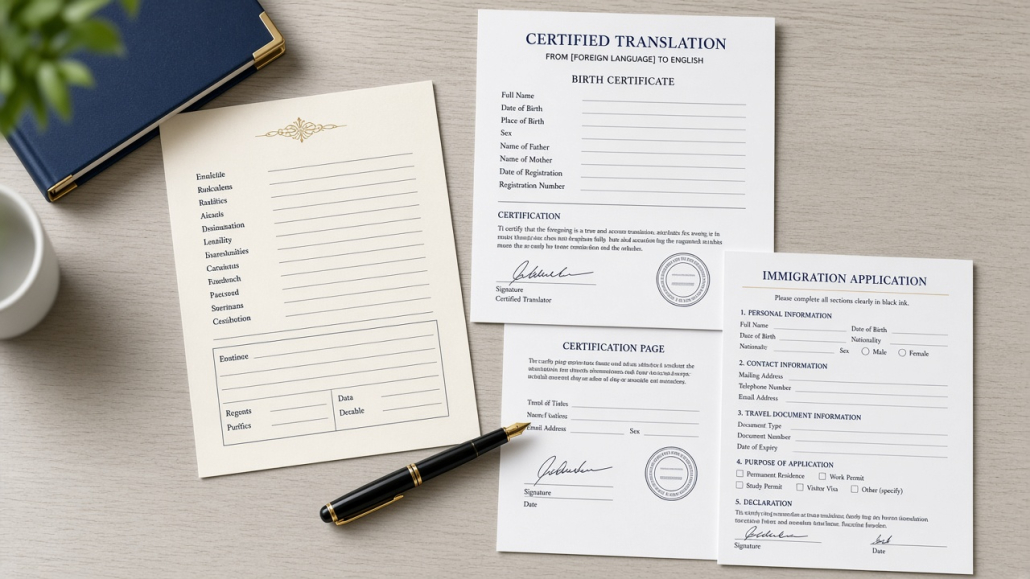
If you are filing a green card, citizenship, or family petition with U.S. Citizenship and Immigration Services (USCIS) and any of your supporting documents are in a language other than English, you will need a certified English translation. This guide explains what the rule actually says, what a certified translation needs to cover, and how to get your documents ready so the translation part of your filing goes smoothly.
What the USCIS rule says
The requirement comes from federal regulation 8 CFR 103.2(b)(3), which covers translations of foreign-language documents.
USCIS requires a full English translation with a certification that it is complete and accurate. Your attorney or the receiving office can confirm any additional requirements.
In plain terms, that gives you two things to get right:
- A full translation. Every part of the document goes into English, not a summary or the highlights.
- A certification of accuracy. A signed certificate of translation from IdiomExpress attesting that the translation is complete and accurate.
USCIS repeats the same requirement on its Tips for Filing Forms by Mail page: supporting documents “must be in English or accompanied by a complete English translation.”
What a certified translation includes
A certified translation for USCIS is two pieces that travel together: the full English translation itself, and a signed certificate of translation from IdiomExpress attesting that the translation is complete and accurate. If either piece is missing, the translation may not match what your form instructions ask for.
Always check the instructions for the exact form you are filing. USCIS updates form editions, and the instructions for your form are the final word on what to include. If a receiving office asks for something specific, tell us before we prepare your translation.
What “full translation” means in practice
This is where many self-prepared translations fall short. A complete translation of an official document usually covers more than the main text, including:
- Stamps, seals, and their wording
- Handwritten notes and signatures (marked as such, for example “[signature]”)
- Printed headers, footers, and reference numbers
- Text on the back of the page
- Marginal notes and later annotations, such as a registrar’s note added years after a birth was recorded
When something cannot be read, a professional translator marks it as illegible rather than guessing. Names, dates, and places should also be spelled the same way across all of your translated documents and your forms, which saves you from avoidable questions later.
Do you need a notarized translation?
The regulation and the form instructions ask for a certification that the translation is complete and accurate. They do not mention notarization. A notary confirms who signed a document. It does not check the translation itself.
Some schools, courts, and foreign offices do ask for notarization, so if you are using the same translation somewhere else, check that office’s requirements too. Our FAQ covers notarization and apostille help if you need either one.
Copies or originals?
USCIS generally wants copies, not originals. Its mail-filing tips say to submit legible copies of official documents and not to send originals unless the form instructions or regulations specifically request them. Originals sent when they were not requested may be destroyed, and USCIS will not automatically return them. The I-485 instructions also note that USCIS may ask for an original document at any time during processing.
A practical routine:
- Make a clear, legible copy of the foreign-language document (every page, front and back).
- Put the English translation and the signed certificate of translation together with that copy.
- Keep your original in a safe place in case USCIS asks to see it.
How to get your certified translation, step by step
- List every foreign-language document your form asks for: birth, marriage, and divorce certificates, police records, court records, diplomas, and so on.
- Scan or photograph each one clearly, including the backs of pages and any attached stamps or notes.
- Check the spellings you use on your forms, so your translation can follow them where the document allows.
- Send everything for a quote. You can request a free quote and upload your files in one step. Tell us which form you are filing and whether you need hard copies or notarization for another office.
- Review the translation when it arrives, especially names, dates, and places, and let us know about anything that does not match your records.
- File the translation, the certificate, and the copy of the original together, as your form instructions describe.
Our certified translation for USCIS is built around those requirements: a full English translation with a signed certificate of translation from IdiomExpress attesting that the translation is complete and accurate. Our team of professional translators works in most language pairs, and every project is reviewed before delivery.
One honest note: USCIS makes its own decisions on every case, so no translation provider can promise how an officer will view your evidence. What we can do is make sure the translation matches the requirements in the regulation and your form’s instructions.
Frequently asked questions
Does a certified translation for USCIS have to be notarized?
No. USCIS requires a full English translation with a certification that it is complete and accurate, and notarization is not part of that requirement. Other offices may have their own rules.
Who provides the certificate?
Every certified translation comes with a signed certificate of translation from IdiomExpress attesting that the translation is complete and accurate. If your receiving office has additional requirements, let us know when you request your quote.
Do I need to send my original documents to get them translated?
No. A clear scan or photo of every page, front and back, is enough for us to translate. USCIS also generally asks for copies, not originals, unless the instructions say otherwise.
Which languages can you translate for USCIS?
Our team of professional translators works in most language pairs. Include your document’s language in your quote request and we will confirm.
Need a certified translation for your USCIS filing? Upload your documents and get a free, no-obligation quote.
— The IdiomExpress Team
This article is general information, not legal advice. For questions about your case, check the USCIS instructions for your form or talk to an immigration attorney.
